Tuesday, November 25, 2008

Dominican Altar Cards

I thought that some of our readers might be interested in seeing a lovely set of "Neo-Gothic / Fra Angelico" altar cards that are in the Western Dominican Province House of Studies, Saint Albert the Great Priory in Oakland. They usually grace the Sacristy, but are occasionally used at the high altar, most recently for the Solemnity of St. Albert the Great this year. The cards were calligraphed and the miniatures painted by two cloistered nuns of the Dominican Monastery in Menlo Park California for the dedication Mass of the chapel in 1948. Here is a picture of them on the high altar as it was dressed for the Solemnity:

The two smaller candles flanking the large six in this photo are the Sanctus Candles used at that Mass. Here is a closer image of the main card:

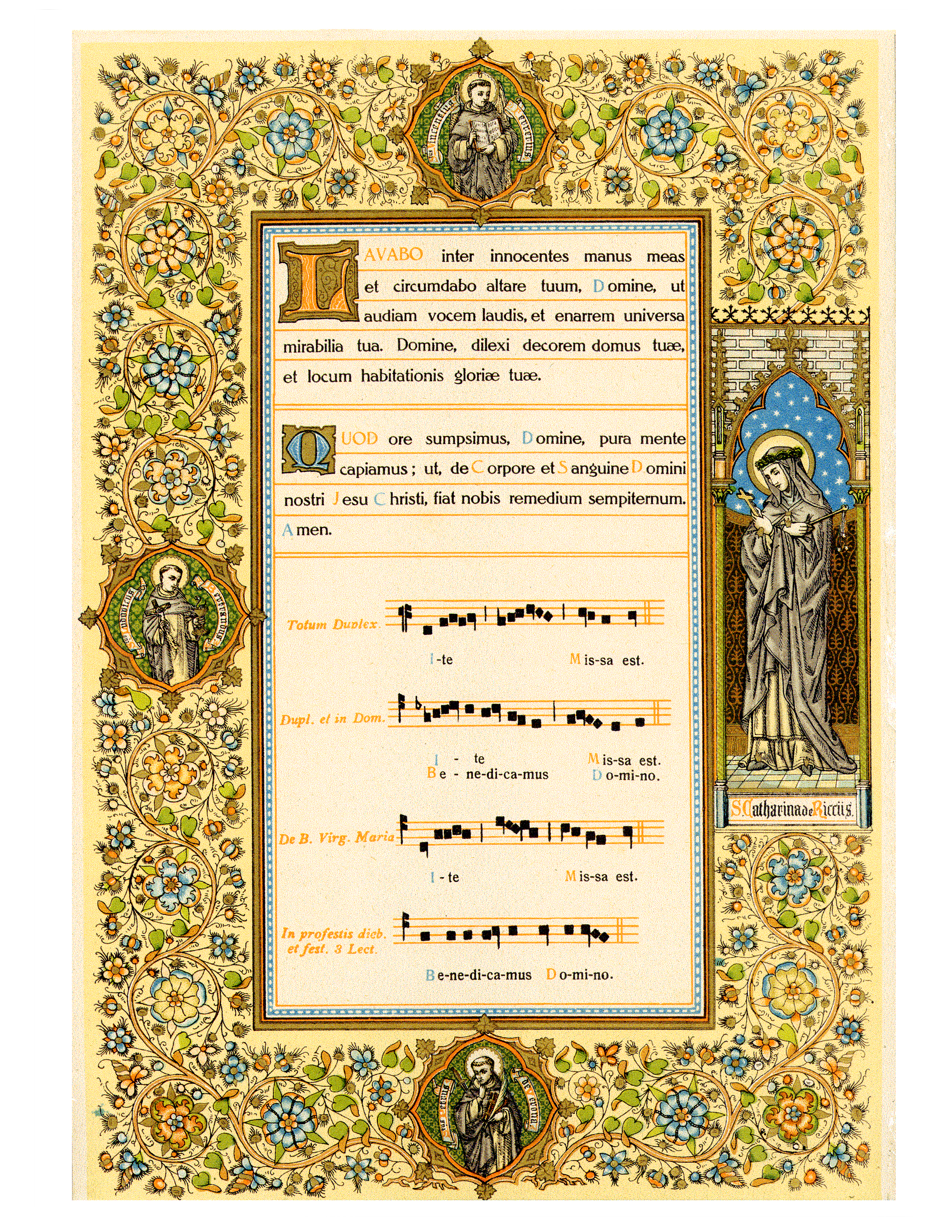
Two Fra Angelico angels grace the sides; in the bottom center is the old Coat of Arms of the Province of the Holy Name, the Western Province. In the top roundels, from left to right, we see St. Albert the Great, patron of the House and of natural philosophy; an angel; St. Thomas Aquinas, patron of theology; St. John and Our Lord at the Last Supper; St. Raymond of Penafort, the patron of Canon law, contemplating the Cross; another angel; and, finally, and St. John of Gorkam, who was martyred by the Calvinists in the Low Countries for bringing the Eucharist to Catholics in prison for their faith. The selection is very suitable for the House of Studies as it includes the patrons of theology, philosophy, and canon law, the major disciplines studied there. The other images are chosen because of their links to the Eucharist. Here is the Lavabo card:

In the left roundel , you can see St. Hyacinth of Poland, who carries a statue of the Blessed Mother, as he did when leading the Polish Dominicans to safety during the Mongol invasions. To the right is St. Vincent Ferrer, the great preacher, who was heard by people in their own languages--thus the fire of the Spirit of Pentecost over his head. In the center quatrofoil, St. Dominic mediating on the Cross. Those with sharp eyes will notice the the Dominican form of the Lavabo psalm is shorter than the Roman. Finally, here is the Last Gospel card:

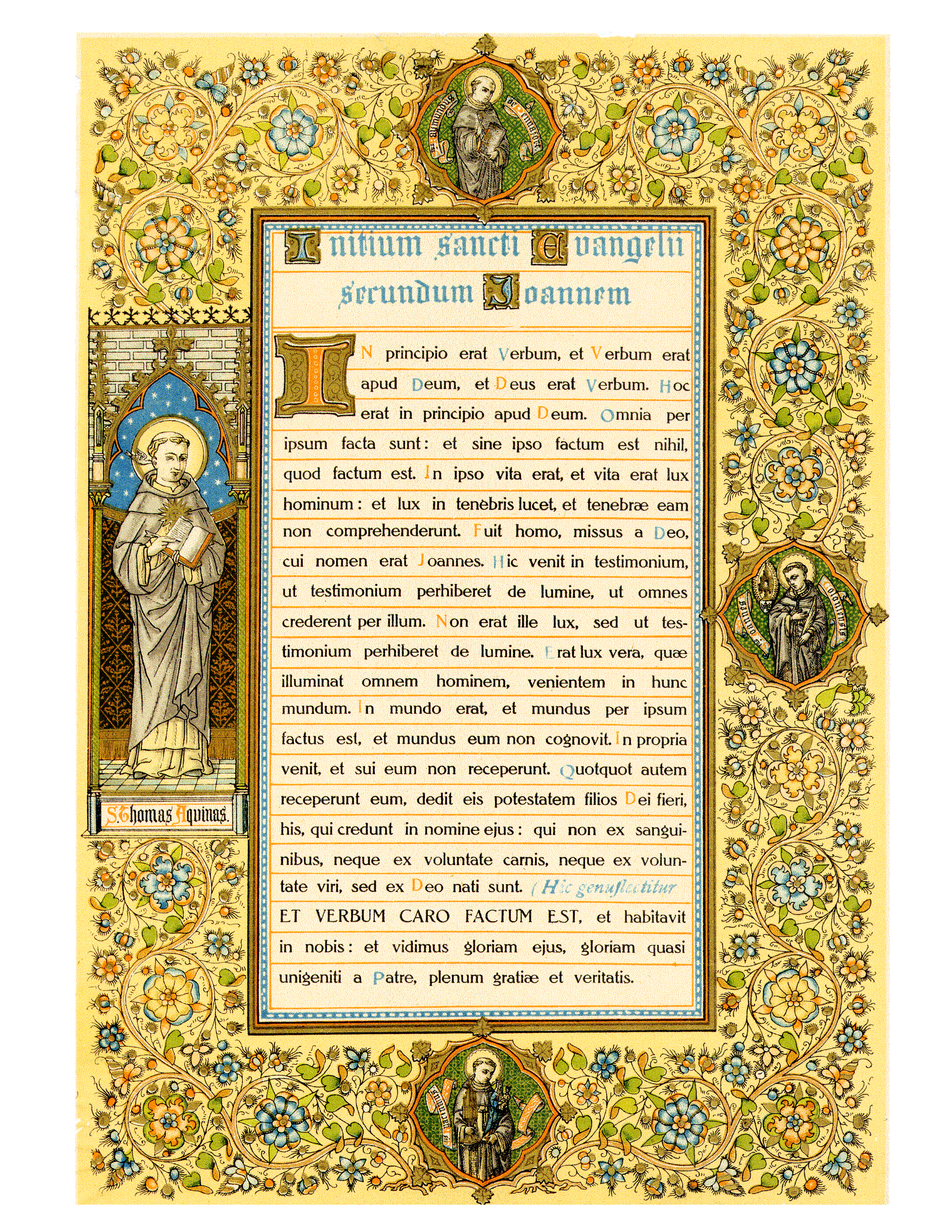
To the left, we see St. Pius V, the reformer of the liturgy and pope of the Battle of Lepanto. As this victory over the Muslim invaders was through the intercession of our Lady of the Rosary, the Virgin and Child are in the center. Last, to the right, is St. Peter of Verona, also known as St. Peter Martyr because he was murdered by Cathar heretics in 1253. He is shown in his traditional form, reminding the friars to keep the Silence. Those with a very sharp eye will notice a tiny error in the punctuation of text of John's Gospel: it is the Roman form, not the Dominican. For more on this see my posting here.

Saturday, November 22, 2008

Dominican Missa Cantata of St. Albert the Great, 2008

On November 15, 2008, at Saint Albert the Great Priory, the Western Dominican Province House of Studies, a Missa Cantata according to the Dominican Rite was celebrated on the occasion of the installation of the new Master of Sacred Theology, who was the celebrant. Photos of this Mass have been posted on the photographer's website, the Western Province Website, and at the New Liturgical Movement.

For the convenience of our readers, and others interested, I have collected these here in one place and provided a short commentary. The first image shows the high altar of the beautiful chapel of the House of Studies.

The next image shows the celebrant and Bro. Ambrose Sigman, O.P., the senior acolyte, and Bro. Gabriel Mosher, O.P., the junior acolyte, waiting for the schola to being singing the Officium, "In Medio." They are standing in the passage way past the side altars leading from the sacristy into the Chapel.

Here are the community and visitors gathered in the choir stalls as the chant of the Officium begins. With the black cappa in the front row, opposite side, can be seen Fr. Gerald Buckley, O.P., the prior of St. Albert the Great Priory. In the blue Yale gown is Fr. Gerald Fogarty, S.J., Prof. of History at the University of Virginia, a colleague of the new S.T.M. Next to him is Donald Prudlo, Asst. Prof. of History at Jacksonville State University in Alabama, a former graduate student of the new S.T.M.

The celebrant and servers have here reached the high altar and are genuflecting before the Reserved Sacrament. You will notice that the celebrant still has his amice-covered capuce up, as a secular priest would still have on his biretta at this point. As the two servers are not ordained they wear the surplice under the shoulder cape of the capuce.


The celebrate as here returned from spreading the corporal and placing the chalice on the altar. With capuce down, he has begun the Prayers at the Foot of the Altar. During these prayers the servers turn in, as they would at Solemn Mass, and make the responses.


The priest has ascended to the altar, kissed it, and moved to the book. He is reciting the Officium quietly as the schola finishes it. The servers have swung to the side of the altar where the book is for the Officium and Kyrie, as they would with the major ministers at Solemn Mass.

After returning to the center to intone the Gloria, and again swinging to the side as for the Officium and Kyrie, the celebrant here returns to the center, turns to face the community and sings the greeting, "Dominus vobiscum."


He celebrant then returns to the book and sings the Collect. The Collect finished, he reads quietly the first reading (from Wisdom in this case) and the Responsorium (Gradual) and Alleluia. This next photo shows him completing that reading.


As he does these readings, the "cleric," who is in this case a priest, Fr. Bryan Kromholtz, O.P., who teaches theology at Dominican School of Philosophy and Theology in Berkeley CA. You will notice that as a priest he wears the surplice over the capuce cape. In the red Harvard robe, you can see Prof. James Gordley, of the Tulane University School of Law, who has collaborated on publications with the new S.T.M.

Here the two acolytes have arrived with the water and wine to help the celebrant prepare the chalice. This preparation is done during the singing of the Responsorium.

Here is the schola about to begin the Responsorium at the lectern "in medio chori." On a major feast such as the patronal feast of the House of Studies, the chantors should normally be at least four--here you can see there were six. They are from left to right, Bro. John Marie Bingham, Bro. Mark Francis Manzano, Fr. Paul K. Raftery (chaplain at St. Thomas Aquinas College in Santa Paula CA), Bro. Boniface Willard (who directed the schola), Stephen Maria Lopez, and Bro. Dominic David Maichrowicz. The visiting academics can all be seen in the front row.

Here we see the preparation of the chalice during the intervening chants. The senior acolyte ministers the wine and stands closest to the altar.

Sadly there are no pictures available of the singing of the Gospel by the celebrant. But here is a photograph of the V. Rev. Fr. Richard Aquinas Schenk, O.P., S.T.M., the regent of studies of the Western Dominican Province. As a Master of Sacred Theology, he wears the biretta and ring (not visible here). He is at the ambo and just about to begin his sermon on St. Albert the Great.

Here is the schola again, waiting for the celebrant to intone the Credo.

Genuflection at Incarnatus est in the Creed:


In the Dominican Rite, the Offertory is every simple, the chalice with paten and host on top is raised in a single oblation as the priest recites one prayer, Suscipe Sancta Trinitas.

Here was see the incensing of the altar at the Offertory. The priest has already incensed the gifts with a single crossing and then the top of the Epistle side of the altar with three lifts (Dominicans do not swing the censer, nor do we clank the chains). Here is has returned to the middle and is incensing the cross with three lifts.

The schola is about to intone the Sanctus.

He celebrant is here quietly reciting the Roman Canon.

The Elevation of the Host. The thurifer, Bro. Raymond Bertheaux, O.P., over fifty years a brother, incenses the elevation continuously, as is the Dominican custom. Earlier, during the singing of the Preface, he incensed the servers and community. In our rite the thurifer is present only from the Gospel to the Elevations, even in the Solemn Mass. You can see a lighted "Sanctus Candle" on the Epistle side (there is another on the Gospel side), which the server lighted during the Sanctus.

Closer view of the Elevation of the Host.

Elevation of the Chalice:


Here, during the singing of the Agnus Dei, we see Fr. Anselm Ramelow, O.P., Asst. Professor of Philosophy at the Dominican School of Philosophy and Theology, who is vested in surplice and stole as he will help distribute Communion. Bro. Matthew Augustine Miller stands in front of him.

Communion and the final collects finished, the celebrant recites the Last Gospel, folds the corporal, raises his capuce, and leaves the altar, as we see in this last photo of the Mass:


More on the program of studies and formation at St. Albert's can be found here. I can also post photos of the S.T.M. installation if readers would like them.

Tuesday, November 18, 2008

Dominican Rite Mass in Anchorage AK


I am delighted to announce that beginning on December 6. 2008, Mass according to the Dominican Rite will be celebrated every First Saturday of the Month at noon in the Cathedral of the Holy Family in Anchorage, Alaska. This initiative has been undertaken with the full support of His Excellency, Roger Schwietz, Archbishop of Anchorage, as well as that of the Rector of the Cathedral, Fr. Francis Hung Le, O.P. The Prior Provincial of the Western Dominican Province, Fr. Emmerich Vogt, O.P., has granted permission for celebration under the terms of the Rescript of 1969.

The first celebrant of the Mass will be Fr. Vincent Kelber, O.P., the associate pastor, who is already well known for his service to the Latin Mass Community in Anchorage . A picture of him vested to celebrate the Mass decorates this posting. The diocesan newpaper, The Catholic Anchor, ran a very well done story on this development in their recent edition. I urge all our readers to read it. It is over all a model of objective and informative reporting. And readers should also note that in order to make these Masses more fruitful to the faithful, the Holy Family Cathedral is offering a Latin class for the Liturgy on Wednesdays, 6:30-8:00 p.m., in Holy Family Education Center.

This means that in the Western Dominican Province the traditional Dominican Rite is now regularly available in four places. The others being Holy Rosary Church, Portland OR; St. Francis Xavier Mission, Toledo WA; and San Buenaventura Mission, Ventura CA. Regularly scheduled Masses are also soon to be instituted at Blessed Sacrament Church, Seattle WA (watch the parish website for announcements). Click on the links for contract information to get specifics. As I played a very, very small role in helping prepare Fr. Vincent to celebrate our Rite, this announcement gratifies me very much.

Monday, November 17, 2008

Master of Sacred Theology Installation (11/15/08)

At the request of a reader and as a permanent record of the events, we are presenting here photos of the installation of Fr. Augustine Thompson, O.P., as Master of Sacred Theology at St. Albert the Great Priory, Oakland CA, the House of Studies of the Western Dominican Province, on the patronal feast, November 15, 2008. If readers would like to consult a copy of the ritual for the ceremony, it is available for download here.

Here is a picture of the chapel prepared for the installation. The Master's Cathedra or Chair is in the center of the presbytery. The altar is dressed from the Missa Cantata that preceded this ceremony. The friars may be seen in the stalls, and there are secular academic vistors in their robes on the left.

Here we see the V. Rev. Fr. Richard Aquinas Schenck, O.P., S.T.M., who conducted the ceremony by delegation from the Master of the Order. He has taken his place in the Master's Cathedra. He wears the insignia of his office, the four-cornered biretta trimmed in purple and the master's ring. You cannot see it but he is also wearing the hood of his highest earned degree, the Doctor Theologiae from the Ludwig-Maximilians-Universitaet (University of Munich), as is the custom in our province. Fr. Richard is the Regent of Studies of the Western Province and Professor of Philosophy and Theology at D.S.P.T. and the Graduate Theological Union in Berkeley CA.

He has now been joined on the left by the V. Rev. Fr. Gerald Buckley, O.P., prior of St. Albert's, wearing the insignia for his theological degree from St. Albert's College, now known as the Dominican School of Philosophy and Theology, the educational establishment of the Western Dominican Province. Representing the prior provincial, he will present the ring. To the right is Fr. Gerald Fogarty, S.J., William R. Kenan, Jr., Professor of Religious Studies and History at the University of Virginia, a colleague of the new S.T.M. He wears the insignia of his Ph.D. in history from Yale University and holds the biretta for the ceremony. In this photo, we see the new S.T.M. making his profession of the Catholic Faith. You can clearly see the new S.T.M.'s academic hood, that of the University of California, Berkeley, where he received his Ph.D. in medieval history.


In this photo Fr. Richard is placing the ring on the new Master's finger, symbolizing his marriage to Holy Wisdom. To the left one can see Dr. Christine Sundt, of the University of Oregon, who designed the ring and her husband, Richard Sundt, Professor of Art History. Both were the new S.T.M.'s colleagues when he taught at the University of Oregon.


Here are two images of the ring designed by Dr. Sundt and engraved and set by Todd Daniels. To the left one can see the shield of the Western Dominican Province, on the right the stone, an amethyst and the shield of the Dominican Order. The initials of the seven S.T.M.s in the history of the province are on the inside of the ring's band. Initials will be added for future S.T.M.s as they are created.


Here Fr. Schenk has placed the new S.T.M. in the cathedra and is reading the formula of installation:


The new Master rises and receives the Kiss of Peace from the other Master present.

Finally, a photo of the beautiful chapel of the House of Studies, with the new Master giving his Inaugural Lecture, "The Soul You Lose May Be Your Own: Historical Reflections on the Task and Temptations of the Theologian." This lecture will eventually be posted in text and video on the web site of the Western Dominican Province.

Tuesday, November 4, 2008

Liturgical Colors in the Old Dominican Rite

Recent discussion on the New Liturgical Movement about the proper color for tabernacle veils and antependia at Requiem Masses, moved me to do some investigation about Dominican practices. The result was something of a surprise, and nothing about it is found in Bonniwell's history of our Rite.

Since the edition of 1687 edition of the Dominican Missal produced under the direction of the Master of the Order Antonin Cloche, O.P., Dominican vestment colors have been identical to those of the Roman use. Before that date, however, the practice was different. Use of white, red, and green basically followed the modern Roman use, but there were interesting exceptions. On simplex feasts of confessors, where the Roman use was white, the celebrant had a choice between using yellow or green. This use of yellow for confessors is a well-known aspect of the Sarum Rite.

The use of green assimilates, at least in the time after Epiphany and Trinity, simplex feasts to the ferial. This is not surprising, as the Dominican Rite of Humbert (1256) and the middle ages resisted the early modern practice of introducing so many saints' days and raising them in so much rank as to erase the ferial office and even that of Sundays (as was generally the case before the Pius X calendar reform). Indeed, the number of feasts above simplex was very limited in the ancient Dominican liturgy, even Apostles were only semidoubles. Although I cannot find any rubric on it, I suspect that the use of the ferial color was also at least an option on feasts of three lessons. In the 1200s and 1300s confessor feasts with yellow vestments included, among others, Gregory the Great, Benedict, Ambrose, Bernard, and Francis. All were only simplex feasts. It is also interesting that the vestment for the "highest feasts" was to be "the best one," but "a violet vestment cannot be used on Easter, nor a white one on Pentecost, nor a red one on Christmas."

Another surprise is the following rubric in the 1868 Ceremonial that does seem to go back to Humbert: "Violet may be used in place of black." This odd phrase speaks to a thirteenth-century development underway in Humbert's time. Innocent III forty years earlier had spoken of the liturgical colors as only "white, red, green, and black." But he mentions that violet has come into use in certain places. This Dominican rubric seems to reflect that older practice of using black not only for Requiems, but also on all other penitential days. So the friars had the option of conforming to the local use of violet during Lent, Advent, and Ember Days, where this had happened, but the assumption was they were still using black on those days as Innocent had considered normal. In 1869, of course, this rubric would also have permitted violet in place of black at Requiems–a practice that seems to have existed even in the Roman Rite in some places up to that time. Lest there be any confusion as to what the current Dominican practice was, the Caeremoniale of 1869 explicitly states that since the promulgation of the Cloche Missal these old rubrics completely abrogated and not to be followed. That they had to say this causes me a bit of suspicion. Were some Dominicans still following them? Perhaps the nineteeth-century French yellow chasuble decorating this post belonged to some French Dominicans?

The question of the interchangeability of black and violet brings up the issue of what color the paraments would be at a Requiem Mass if the Blessed Sacrament were reserved on the altar. Here what the Caermoniale of 1869 says and does not say is very interesting. About the tabernacle veil we read the following: "The exterior of the tabernacle is to be decently covered by a canopy (conopaeum). The canopy is to be of cotton, woolen, or hemp cloth, and to be white in color or, better, matching the color of the office of the day." The form of this rubric (which is not in Humbert) suggests to me, at least, that the specification "cotton, wool, or hemp" (gossypio sive lana sive cannabe), instead of "silk" (serica), is quite ancient and that the use of material matching the vestments, which would have been in silk, is later. Notice there is nothing to exclude use of any color of the day, including black. And I was unable to find any rubric to forbid a black conopaeum.

So, as of 1869, there was no formal rule in the Dominican Order against use of black tabernacle veils or black antependia on an altar with a tabernacle. But I suspect this was not the practice because of a related rubric. This involves an altar on which there is on-going Exposition of the Blessed Sacrament. In that case, the altar paraments are all to be white, "even if that does not match the color of the vestments for a Mass being celebrated at it." This, of course, concerns Mass in the Presence of the Sacrament Exposed. Again, however, nothing is said about violet or black when the Sacrament is not exposed. Nevertheless, although the rubrics are silent, the earlier specification that the conopaeum may always be white, and the association of the Blessed Sacrament with white here, suggests that perhaps the practice in 1869 might have been to use a white conopaeum at Masses using black vestments at an altar with a tabernacle. But finding out what was actually done in our priories will require much more work than I am ready to undertake right now.

As it is my understanding that the debate over use of black or violet antependia at altars with tabernacles in the Roman Rite was only resolved in the mid-twentieth century, I am not surprised about the lack of clarity in the 1869 Caeremoniale. In any case, I suspect in the last century at least, many Dominican parishes probably just followed whatever the local Roman practice was. The medieval rubrics for Dominican vestment color options seem to envision this kind of accommodation to local practice. And I can assure you that not doing something the "Roman Way" can generate unpleasant comments from those who attend Dominican Rite Masses and from those who see pictures of them. The pressure on Dominicans to follow the common practice, alien to our traditions as it might be, will always be great.

Thursday, October 30, 2008

Regulae Cantus (1965) Now Available

I am pleased to announce that, through the work and kindness of Br. Gregory Schnakenberg, O.P., we now have available for consultation and download on the left side bar here at Dominican Liturgy a scan of the Tonorum Communium iuxta Ritum Ordinis Praedicatorum Regulae, usually called the "Regulae Cantus," published in 1965.

This booklet revised the traditional manner of chanting the pslams, readings, and prayers, conforming them to the Benedictine/Roman method developed by the monks of Solesmes. The traditional Dominican melodies were preserved, but the way in which they were adapted to the Latin words was changed to match the general practice of the Church. This book is not merely of historical interest as the method of psalm-singing in it is that in use by Dominican houses, such as the Angelicum in Rome, which sing the Liturgia Horarum in chant. This booklet also provides the norms for prayers and readings when Dominicans celebrate the Roman Ordinary Form Mass using our own musical tradition, as was provided for in the Rescript of 1969 by which we adopted the Roman Rite.

Those who would like to compare this music with the original Dominican methods may find the pre-1965 rules in the Processionale, also available for download on our side-bar. The original tones are also available on line in the Poissy Antiphonal of 1335, which is also linked from the side-bar. A page of that manuscript decorates this posting. Those who know the Benedictine music will immediately notice the much reduced number of terminations in the Dominican use (only 16 total for the eight tones) and that the chants for the Epistle and Gospel match those listed in the Roman Gradual as "ancient more authentic tones."

This booklet also includes the music for the Psalms and Antiphons of Dominican Rite Compline using the new method and provided with Solesmes marks. The only other Dominican music books using the Solesmes notation system produced were those for Holy Week and Compline. I hope that we will eventually be able to make those also available. As this seemed a suitable time, I have also reposed here at Dominican Liturgy my short explanation of how to interpret and sing Dominican chant.

Wednesday, October 29, 2008

How to Sing Dominican Chant (reposted by request)

PART ONE: NOTATION

Those who know Gregorian music, especially with the so-called Solesmes marks, are often surprised when they first encounter printed versions (or on-line manuscript) versions of Dominican chant. The first thing they notice is the complete absence of the Solesmes marks: epistema, dot, ictus, etc. The next thing they notice is that there is no quilisma. The so-called "expressive neumes" are totally absent. Then there is that funny Dominican quarter bar: it is not on the top line of the staff, but moves up and down to the height of the note it follows. And the double bar appears where in the Roman books one expects an asterisk. Finally they notice that the liquescents often appear on diphthongs and liquid consonants where they are lacking in Roman music.

Modern Dominican books reproduce the shape of the neumes in the medieval manuscripts of our music, which were based on the Humbert of Roman Codex exemplar of 1254, which still exists as MS 1 in the Domincan Archives in Rome. In order to sing our music properly, cantors need to know the system of interpretation explained in the treatises of Jerome of Moravia (d. after 1271. probably Scottish), a Dominican musicologist, who codified traditional practice. An image of his treatise De Musica, copied at the beginning of every medieval Dominican Antiphonal, is at the top of this post. It is from the fourteenth-century Poissy Antiphonal.

His system for rhythm is presented in an accessible, albeit Latin, form in the Dominican Processionarium of 1949. The Dominican system of adapting psalm tones to the psalms found in that book was suppressed in 1965 with the publication of the post-Vatican II Regulae Cantus in favor of the Benedictine method, although the Dominican melodies of the tones were left unchanged. But for all other chants, the thirteenth-century system continues in use today, in continuity with the living tradition of chant extending in an unbroken line back to the earliest days of the Order. The most important section of the Regulae Cantus for interpreting the chant is Section III, "De pausis et earum signis et proportione." I have adapted that section for use by choirs, and will present it in another post, but first singers need to know certain things.

1. Dominican and Gregorian neumes mean the same thing as to relative pitch on the staff as indicated by the clef. Those who do not know how to read neumes and what their names are, should consult the many books and on-line aids that explain this before reading any further.

2. In our chant, the two liquescents (the Ephiphonus and the Cephalicus) normally indicate a diphthong or liquid consonant. Since, in normal speech, the two sounds of the diphthong slur into a single vowel and the liquid is a semi-vowel merging into the following or preceding vowel, the two notes in these neumes do not get equal length because of a palatalization (touching tongue to roof of mouth). It is often said that the small note is "shorter" than the bigger one, but strictly speaking they are really about the same--it just seems shorter because of the palatalization. The same is kind of neume (but without the little note) is used for liquescents even when they do not indicate a diphthong or two distinct notes. A careful student will notice that we regularly use liquescents where Benedictine and Roman music has the two sounds of a diphthong sung on two distinct puncta, e.g., the separation of the "e" and "i" of the "ei" in Eleison.

3. The double bar in our system has two uses. They are very different and have some variations. Here they are:

3A. Most commonly, the double bar indicates the end of a major phrase, at which one side of the choir stops singing, and the other side takes over, following the traditional system (not only Dominican) of "antiphonal singing." This meaning is especially common in Kyries where the last Kyrie is sung by one choir, then the other, then both together. This shift is indicated in Roman books by asterisk and double asterisk. We use double bars. This use of the double bar also indicates a lengthening of the last syllable(s) of the phrase according to a system I will explain later.

3B. The double bar also appears at the beginning of a chant, after the first word or couple of words: there it indicates where the choir comes in to join the cantor who has intoned the piece. It functions like the asterisk in Roman chant. In this case, it does NOT indicate any lengthening of the previous notes.

3C. An interesting variant of this is found in Dominican books for the Gloria. There is one double bar to indicate the end of the priest's intonation phrase: "Gloria in excelsis Deo." But then there is another double bar at the end of "et in terra pax," an odd place to put it. This phrase belongs to the cantor. The choir comes in after that second double bar on the word "hominibus." Why? Many priests cannot sing for beans. They will foul up the intonation, but in the old rite they had to do it. So, the choir ignored what the priest sang and waited to hear the correct pitch and melody from the first cantor. Many priests simply recto-toned their intonation. The Gloria is the only place where this system is used.

4. Expressive neumes and quilisma do not exist in Dominican music. They did not exist as far as I know in any thirteenth-century chant manuscript. The expressive neumes are the product of Solesmes theorists. The quilisma is founded on the appearance, at certain places in the pre-staff notation, of a kind of fuzzy squiggle. There have been long debates over what it meant. My personal opinion is that it originally indicated the half-step and had no phrasing significance. Prof. William Mahrt of the CMAA, with whom I have discussed this, says that is very possible I am right, although he thinks it indicated a light vibrato. Good news! None of this matters for those singing Dominican chant because we don't have any of these flourishes.

PART TWO: RHYTHM

The most debated and controversial issue in performance of Gregorian Chant since its nineteenth-century revival has been the issue of rhythm. The earliest manuscripts with Gregorian music have no staff and so present grave problems of interpretation for pitch and intervals. But they do have a whole series of other marks that in part seem to indicate phrasing and rhythm. Manuscripts after the eleventh century have a staff with a clef to indicate "do" or "fa" and so solve the interval problem, but they seem to have little or anything to indicate phrasing and rhythm.

The modern science of musical semeiotics has attempted to resolve this problem. The Solesmes marks and system(s) allow an interpretation of both pitch and rhythm. What I am about to describe is how Dominicans have dealt with the problem of rhythm since the 1200s. I do not claim that this system is "better" than any of the modern Solesmes methods, including that of Dom Mocquereau, currently in favor with workshops sponsored by the Church Music Association of America. Those who want to sing Dominican music, however, cannot use that method because it depends on the presence of Solesmes marks, and these do not exist in our books.

Principles of Phrasing

As you read these principles, you can consult the sample image of various bars and neumes from the Processional, pasted here:

1. The most important determination of phrasing is the meaning of the Latin text. Dominicans break the text into what might be called longer phrases, and then break the longer phrases into shorter ones. This is the way we punctuate English. A period or semicolon indicates the end of a major phrase; the comma (or implicit unwritten "comma") indicates a "joint" between the shorter clauses.

2. The punctuation marks of Dominican chant are the double bar (A), the single bar (E), and the half bar (D). The quarter bar (C), which moves up and down, is NOT a punctuation mark. The single bar and double bar are very similar: both indicate a full stop and a point at which a full breath may be taken. The difference is that after a double bar, the other choir takes up the new phrase; the same choir continues to sing after the single bar. In small choirs it is common not to alternate between choirs. In that case, both of these bars are treated the same way--although it is common to make the pause after the double bar a bit longer since it sometimes (as in hymns) indicates a new stanza. The half bar indicates a minor break or joint in the phrase. The pause is shorter and a short breath may be taken.

3. The quarter bar is not a rest or a break; its function is similar to the Solesmes dot. It serves ONLY to lengthen the previous note. No breath is taken at a quarter bar. There is no break in the phrase. Back at choir practice in our Western Dominican House of Studies in Oakland during the 1970s, this was called the "don't breath here bar." Some people even cancelled them out with a pencil and put in a dot instead. Although lazy singers often took a breath at quarter bars (and the lengthening of the previous note tended to cover this), it is very bad form and ruins the phrasing. It is better for people to stagger their gasps for breath at any place other than a quarter bar.

4. Although it is not noted in the music by any mark, singers "take off" (slightly accelerate) as they begin a phrase, and "make a landing" (slowly retard) as they end the phrase. They do this in a more delicate way in the minor phrases ended by half bars. This acceleration and retard is so delicate that it should be hardly noticeable, just as the similar change in velocity is hardly noticeable in ordinary speech.

5. Singers hold the syllable(s) that precede the bar, be it a double, single, half, or quarter bar. This is distinct from the gentle progressive retard of the "landing." The proper way to do this is to slow down, hold, and taper off in volume so as to let the note fade away. Avoid, at all costs, staccato stops.

6. In music with one neume per syllable, the number of syllables held is determined by accented (or virtually accented) syllable.

6A. Lengthen the last syllable before the bar if the word there a monosyllable (e.g., "te").

6B. If the word has more than one syllable (e.g., "nobis"), and the penult (second to last) is accented, lengthen that and the final syllable.

6C. If two syllables follow the accented one (e.g, "Dominus"), lengthen the last syllable only: it is considered "virtually accented."

6D. So, you never lengthen more than two syllables.

6E. Finally, if you are singing a hymn, sequence, or other music with a poetic meter, ignore these rules and lengthen ONLY the last syllable of the line.

7. In melismatic chants, i.e., those with more than one note per syllable, lengthen only the last neume or part of a neume.

7A. If the last syllable of the last word is melismatic and the penult is a simple punctum, you lengthen only the last syllable, even if the penult is accented. Conversely, if the if the last syllable has a punctum and the penult is melismatic, you lengthen only the last syllable, even if the penult is accented.

7B. When the last syllable has or ends with a two-note neume, e.g. a podatus or a clivus ( see B above), lengthen both notes of that neume.

7C. When the last syllable has a meume with three or more notes (see F above), lightly retard but hold only the last note in the neume.

7D. In very melismatic music, such as Alleluias and Responsories, there will be a part of the multi-note neume at the end, usually a clivus, podatus, or torculus. This part of the neume is often detached, as is the case in B and F above. Hold that part of the neume only, using rules 7B amd 7C.

8. Strive to sing all chant legato. This is very important to phrasing. At the end of all phrases avoid staccato stops. Let your voice volume taper off to silence. Do not gasp for breath; if necessary, stagger your breathing.

That's all there is to the system. It may seem more complex than having the Solesmes marks to tell you what to do, but, in fact, it is very natural and intuitive. And it seems, from writers like Jerome, that all thirteenth-century singers of chant sang this way, or in a very similar way. So, now you twentieth-century singers can sing the music in the new Roman liturgical books like the Missal, where there are no Solesmes marks!

PART THREE: AN EXAMPLE
The Salve Regina

If you do not have the French Dominican C-D Dominican Chant-Dominican Liturgy, which has the example discussed on track 20, you can order it here.


Here is the music of the famous Dominican Salve Regina used all year after Compline, taken from the Antiphonarium. Take a look at it and I will apply the principles of phrasing I explained earlier. If you have the French Dominican recording of this, you might listen along as you read, in it you can hear how the phrasing and the lengthening of ending notes merge into an organic whole. They are also very good on distinguishing the strong retards at the end of major phrases from the lesser ones of the shorter clauses that make them up. To allow you to consult the rules given in the last post, I will reference them in brackets as I comment.

Phrase 1 "Salve Regina, Mater misericordiae.

This is a major phrase with a break in the middle after Regina indicated by the half bar. So the major rhythmic phrase is the whole verse and there are two minor phrases [rules 1, 2]. The take-off begins on Salve and the landing on "ae" of misericordiae. There is a light touch down on "na" of Regina because of the half bar. This kind of subtle articulation is always observed in the rest of the antiphon at the various breaks, so I will not repeat it [rule 4].

There are no "true" double bars in the antiphon Salve Regina until its end because it is traditionally sung by all, not alternately by choirs. That first "double bar," after Salve, does no more than indicate the place to which the cantor sings and at which all come in. There is no lengthening of "ve" since this double bar represents merely that the choir comes in. The clivus on "na" of Regina is lengthened, but not the melisma on "ce" of dulcedo because even though "ce" is accented, it has a compound neume [rule 7A]. The same is true of misericordia, where "cor" is accented, but the second to last note is melismatic: so only the simple neume on "ae" is lengthened [rule 7A].

Phrase 2: "Vita, dulcedo et spes nostra, salve."

This major phrase has joints after Vita and dulcedo, indicated by the half bars. The mark after nostra is a quarter bar--equals a Solesmes dot, not a phrasing mark, so it does not divide a phrase and no breath is to be taken [rule 3]. The final syllables "ta" "do" and "ve" are lengthened, but not any previous notes because the previous notes are all melismatic [rule 7A]. The melismatic neume on "tra" of nostra is lengthened because of the quarter bar, but only on the two notes of the podatus [rule 7B].

Phrase 3: "Ad te clamamus exsules filii Hevae."

This major phrase has a joint after clamamus indicated by the half bar. Notice the two quarter bars. The compound neume on Ad ends in a Ephiphonus, which scants the smaller note. The quarter bar lengthens te but without pausing or breath [rule 6a]. Only "mus" of clamamus and the "vae" of Hevae are lengthened because the previous accented syllables have melismas [rule 7a]. The last two notes of the porrectus on "les" of exsules are lengthened without a pause because of the quarter bar [rule 7B].

Phrase 4: "Ad te . . . valle" contains nothing new. Apply rule 6A to te, 7A to clamamus, 7B to hac, and 7A to valle.

Phrase 5: "Eja ergo advocata nostra."

The phrase is jointed after ergo by the half bar. The odd looking podatus over the "E" of Eja is composed of a regular punctum and the large note of the liquescent Chephalus because the "j" is a semivowel: but this has no affect on phrasing. Notice the liquescent Ephiphonus on "er" of ergo because r is a liquid. Because that Ephiphonus is a compound neume only the "go" is lengthened by the half bar, even though "er" is the accented syllable [rule 7A]. In contrast, nostra is a bi-syllable with simple neumes on each one: so since "nos" is accented, both syllables are lengthened [rule 6B].

Phrase 6: "illos tuos . . . converte."

There is nothing new here except the lengthening of the last note only of the neume on "los" of oculos because it is a three-note neume [rule 7C]. Otherwise, apply 7A on tuos, 7B on misericordes, and 7A on converte.

Phrase 7a: "Et Jesum benedictum fructum ventris tui, nobis . . ."

This is routine: apply 7B on Jesum, 7A on fructum, tui, and nobis. The next part of this phrase has items of interest. Here it is with the rest of the antiphon:


Phrase 7b: "post hoc exilium ostende."

Note the lengthening of both notes of the clivus on "um" of exilium by the quarter bar, even though "si" is the accented syllable [rule 7B]. Notice also the big note (without the small) of a Ephiphonus on "sten" of ostende because "n" is a liquid--but this has no effect on singing. Both "sten" and "de" are lengthened here because they have simple neumes and "sten" is accented [rule 6B].

Phrases 8-9: "O clemens" and "o pia": nothing new. Apply 7B to both of the Os; apply 7A to clemens and pia.

Phrase 10: "o dulcis virgo Maria."

The joint in the phrase is at the half bar, which is actually in the middle of the notes on O. Note the quarter bar along with that half bar in the melisma on O. The quarter bar, as usual, lengthens the last two notes of the first neume on O without a pause or break [rule 7B]. The next neume on O after the quarter bar is lengthened only on its last note by the half bar because it has four notes [rule 7C]. Although it might seem bad form in Benedictine chant, we Dominicans normally take a small pause and a little breath, here at the half bar before attacking the rising notes that complete the melody on O, which are not lengthened because no bar follows. (Those with the French recording will notice that the French Dominicans manage to sing this without taking a breath here--a particular interpretation which may reflect a variant in the Competorium book.) The phrasing joint in this passage comes here in the middle of the run on the O. This is a not uncommon practice in Dominican chant, especially in Responsoria. Perhaps it is a concession to less disciplined non-French friars who, unlike monks, cannot sing through long runs in a single breath.

On dulcis, note the liquescent because of the "l" and that only the podatus is lengthened by the quarter bar [rule 7B]. There is a one note liquescent on "Vir" because of the "r". Finally, note that only the two notes of clivus on "a" of Maria are lengthened not the neume on the previous accented syllable [rule 7B].

Phase 11: the Alleluia.

The antiphon normally ends with Maria, so there is a double bar after it, but in Paschal time the Alleluia is added. Since there is no choir change before the Alleluia, the double bar magically equals a single bar. There are two things to notice in the Alleluia: the lengthening of the two notes of the clivus on "lu" by the quarter bar [rule 7B], with, as usual, no breath or pause before adding the last three notes. Finally, "ia" has a clivus, both notes of which are lengthened, but not the podatus on the accented syllable [rule 7B].

I hope this clarifies the rules given in my previous posts. If you notice any errors in my cross references, let me know. I think I typed them all out correctly.

Friday, October 24, 2008

Bonniwell Ceremonial now Available.


I am delighted to announce that Fr. William R. Bonniwell, O.P.'s Dominican Ceremonial for Mass and Benediction (New York: Comet, 1946) is finally available for download on the left sidebar under "Dominican Rite Texts." We are indebted for this scan to Fr. Paul Keller, O.P. This completes the presentation of the three rubrical works for celebration of the Dominican Rite most useful for English speakers: the others being the Jandel Caeremoniale [Latin] of 1869 and the St. Joseph Province Altarboys' Manual of 1945. Both also available in the same place.

Although Fr. Bonniwell describes some practices that seem particular to the American Eastern Province (e.g. the use of the Roman order for lighting altar candles), the rubrics explained faithfully reflect those of Jandel and the Missal of 1933. None of the practices described here were modified by the rubrical reforms of 1961-62, with the exception of the suppression of the Communion Confiteor and imposition of the Roman Ecce Agnus Dei, and the use of Benedicamus Domino in place of Ite Missa est on ferials and lesser feasts. Other changes at that time principally dealt with the calendar and multiple collects, topics not discussed in this book.

This ceremonial is especially useful for the parallel tables presenting the actions of the major minsters at Dominican Solemn Mass.

Sunday, October 12, 2008

Rosary Blessings and Indulgences

As this is the month of the Most Holy Rosary, I have been asked to post something about the blessing of the Rosary and the spiritual benefits granted to those using it.

Until the promulgation of Inter Oecumenici in 1964, the blessing of Rosaries was a reserved blessing, and only priests of the Dominican Order could bless them. That is why the older Roman Rituals did not contain a blessing for Rosaries. Today any priest or deacon may bless a Rosary using formulas in use from 1964 to 1984 or the formula found in the new Liber Benedictionum of 1984 (LB 506):

May this Rosary and the one who uses it be blessed, in the name of the Father, and of the Son, + and of the Holy Spirit. R/ Amen.

Dominican priests, however, may wish to use the blessings proper to our order. The first of these is a longer formula which is especially suitable when blessing Rosaries for members of the Rosary Confraternity:

BENEDICTIO ROSARIORUM [LONGIOR]

Sacerdos stolam albam deferens, dicit:

V/. Adiutórium nostrum in nómine Dómini.
R/. Qui fecit cælum et terram.
V/. Dóminus vobísum.
R/. Et cum spíritu tuo.

Orémus.
Omnípotens et miséricors Deus, qui proper exímiam caritátem tuam qua dilexísti nos, Fílium tuum unigénitum, Dóminum nostrum Iesum Christum de cælis in terram descéndere, et de beatíssimæ Vírginis Maríæ Dóminæ nostræ útero sacratíssimo, Angelo nuntiánte, carnem suscípere, crucémque ac mortem subíre, et tértia die glorióse a mórtuis resúrgere voluísti, ut nos eríperes de potestátem diáboli: obsecrámus imménsam cleméntiam tuam ut hæc signa (vel hoc signum) Rosárii in honórem et laudem eiúsdem Genetrícis Fílii tui ab Ecclésia tua fidéli dicáta (vel dicátum) bene- + dícas et sanctí- + fices, eísque (vel eíque) tantam infúndas virtútem Spíritus + Sancti, ut quicúmque horum quódlibet (vel hoc) secum portáverit, atque in domo sua revénter tenúerit, et in eis (vel eo) ad te, secúndum huius sanctæ Societátis institúta, divina contemplándo mystéria, devóte oráverit, salúbri et perseveránti devotióne abúndet, sitque consors et párticeps ómnium gratiárum, privilegiórum et indulgentiárum, quæ eídem Societáti per Sanctam Sedem Apostólicam concéssa fuérunt, ab omni hoste visíbli et invisíbili semper et ubíque in hoc sculo liberétur, et in éxitu suo ab ipsa beatíssima Vírgine María Dei Genetríce tibi plenus bonis opéribus præsentári mereátur. Per eúndem Dóminum nostrum Iesum Christum Fílium tuum, qui tecum vivit et regnat in unitáte eiúsdem Spíritus Sancti Deus, per ómnia saecula sæculórum. R/. Amen.

Aspergantur aqua benedicta.

Here is the approved translation into English prepared by the Irish Dominican Sisters for the Appendix of the English translation of the Dominican Breviary:

BLESSING OF ROSARIES: LONGER FORMULA

The priest wears a white stole, and says:

V/. Our help is in the name of the Lord.
R/. Who made heaven and earth.
V/. The Lord be with you.
R/. And with your spirit.

Let us pray.
Almighty and merciful God, on account of your very great love for us, you willed that your only-begotten Son, our Lord Jesus Christ, should come down from heaven to earth, and at the angel's message take flesh in the most sacred womb of Our Lady, the most blessed Virgin Mary, submit to death on the cross, and then rise gloriously from the dead on the third day, in order to deliver us from Satan's tyranny. We humbly beg you, in your boundless goodness to bless + and to sanctify + these rosaries, which your faithful Church has consecrated to the honor and praise of the Mother of your Son. Let them be endowed with such power of the Holy Spirit, that whoever carries one on his person or reverently keeps one in his home, or devoutly prays to you while meditating on the divine mysteries, according to the rules of his holy society, may fully share in all the graces, privileges and indulgences which the Holy See has granted to this society. May he always and everywhere be shielded from all enemies, visible and invisible, and at his death deserve to be presented to you by the most blessed Virgin Mary herself, Mother of God. Through the our same Lord Jesus Christ, your Son, who lives and reigns with you in the unity of the Holy Spirit, God for ever and ever. R/. Amen.

They are then sprinkled with Holy Water.

When the blessing is not done for members of the Confraternity or when brevity is more suitable, the shorter formula may be used:

BENEDICTIO ROSARIORUM BREVIOR

Ad laudem et glóriam Deíparæ Vírginis Maríæ, in memóriam mysteriórum vitæ, mortis et resurrectiónis eiúsdem Dómini nostri Iesu Christi, bene- + dicátur et sancti- + ficétur hæc sacratíssimi Rosárii coróna: in nómine Patris + et Fílii, et Spíritus Sancti. R/. Amen.

Si plura sint rosaria benedicenda, formula pronuniatur in plurali. Stola et aqua bendicta ad libitum.

Again, the official translation of 1967:

BLESSING OF ROSARIES: SHORT FORMULA

To the honor and glory of Mary, the Virgin Mother of God, in memory of the mysteries of the life, death, and resurrection of our Lord, the same Jesus Christ, may this crown of the most holy Rosary be blessed + and sanctified + in the name of the Father, + and of the Son, and of the Holy Spirit. R/. Amen.

If several Rosaries are blessed the plural is used; use of stole and holy water are optional.


ROSARY INDULGENCES

Since mention was made in the longer blessing of the indulgences attached to the Rosary and to the privileges of members of the Rosary Confraternity, readers may be interested in this. With the publication of the Enchiridion Indulgentiarum in 1968, all general indulgences previously granted were terminated and replaced by those contained in that book. The indulgences attached to the Holy Rosary are:

1. A plenary indulgence is granted under the usual conditions, to those who recite five decades of the Rosary in a church, or in a public oratory, or with a family group, religious community, or pious association. Otherwise a partial indulgence is granted. (EI 48)

2. A partial indulgence is granted to those who use a Rosary blessed by a priest, even if five decades are not recited. The indulgence is plenary on the feast of Sts. Peter and Paul, if the blessing was performed by the pope or a bishop. (following EI 35)


SPECIAL PRIVILEGES OF ROSARY CONFRATERNITY MEMBERS

The publication of the Enchiridion also abolished all indulgences granted to particular organizations or individuals unless they formally petitioned to have these reconfirmed. The Rosary Confraternity did so petition, and the following plenary indulgences are granted to enrolled members when they recite five decades of the Rosary, even if not in a church or with a group:

1. On anniversary of the member's day of enrollment. (When application is made, a certificate of membership is sent, indicating the day of the enrollment.)

2. On the following feast days: Christmas, Easter, Annunciation, Purification, Assumption, Our Lady of the Rosary, and Immaculate Conception.

More information the Rosary is available at the Rosary Center Website.

If you are interested in joining, click here for on-line registration in the Confraternity of the Holy Rosary.

The forms for Dominican blessings of the Rosary are now available in downloadable form on the left sidebar under "texts."

Tuesday, September 30, 2008

Dominican Altarboys' Manual (1945)


I am pleased to announce that, through the kindness of Fr. Paul Keller, O.P., we now have available on our sidebar under "Dominican Rite--Texts" a scan of the

Dominican Altarboys' Manual according to the Rite of the Order of Preachers: Compiled from the Dominican Ceremonial (New York: Province of St. Joseph, 1945).

This booklet presents very complete instructions and photos on how to serve the Dominican Rite Mass in the Low Mass, Missa Cantata, and Solemn Mass forms. Although there have been some accomodations to Roman practice (e.g., the manual gives the Roman, not the Dominican, order for lighting the altar candles), these do seem to represent the customs in force in the Eastern Dominican Province before the Council.

This text may be downloaded in PDF format, for printing or consultation on your computer, either on the sidebar to your left or here. This text will be especially helpful for communities where the Extraordinary Use of the Roman Rite is celebrated and a Dominican comes to fill in and prefers to celebrate in his own Rite--as, with his provincial's permission, he has the right to do. This resource now allows all servers to be properly prepared for such a necessity.

Wednesday, September 3, 2008

"Visit" Our Sisters, the Dominican Nuns of Summit NJ


Over the years I have been blessed to have spent time with the Dominican Cloistered Nuns of Summit, New Jersey, giving them talks on various subjects in Church History and theology. On all those occasions I have also had the spiritual enjoyment of their lovely monastery (see photo to the right) and their beautiful chanting of the Mass and Office.

Sr. Mary Catherine, their novicemistress, who has responsibility for their five (right?) aspirants, has often posted comments here and at New Liturgical Movement. As a gesture of Dominican Solidarity with the oldest branch of the Order (the nuns predate the friars by several years), I would urge our readers to stop over and visit there website. And while you are their you can read about their Capital Campaign to begin renovations of their monastery and you might even order some of their famous Seignadou Soaps! Below is a picture of Sister with the women she is helping form in Dominican Contemplative life. They have just completed a baking project -- yum!