Saturday, January 24, 2009

Dominican Nuns of Summit Discovered by Time-CNN


Dominican Liturgy is delighted to hear that the Dominican Nuns of Summit NJ have been made the subject of a beautiful photo essay by Time-CNN.

It includes novices and professed sisters speaking in a simple way about their vocations. Here is the link:

Radical Love

After watching this, our readers might want to visit the sisters website, or perhaps their vocations page.

And don't forget their Cloister Gift Shoppe!

Friday, January 16, 2009

Holy Rosary Church: Palestrina Mass of Dedication


Fr. Anthony-M. Patalano, O.P., pastor of the Dominican Parish in Portland, Holy Rosary Church, has asked that I advise our readers of an up-coming event there.

Holy Rosary Church will mark its 115th Anniversary on Sunday, 25 August, at the 11:00 A.M. Mass. The V. Rev. Gerald A. Buckley, O.P., Prior of the Western Dominican Province House of Studies, Saint Albert the Great Priory in Oakland CA, who was pastor at Holy Rosary from 1981-83, and who brought Cantores to this parish will celebrate Mass in Latin according to the Ordinary Form.

Cantores in Ecclesia will sing Palestrina's Missa Emendemus and the Plainsong Propers for the Feast of the Dedication of a Church. Holy Rosary is a dedicated church, and the date of the consecration was 28 January 1894, then the feast of the Translation of the Relics of St. Thomas. In the new calendar, so as not perpetually to impede the Feast of the Angelic Doctor, Holy Rosary Parish celebrates the dedication on the closest Sunday. Fr. Patalano invites any readers in the Portland area to attend the celebration and introduce themselves.

I might add that Fr. Patalano is the conference chair for The Living Tradition: The Dominican Rite in the Twenty-First Century, which will be held at Saint Albert the Great Priory in Oakland CA, 5-9 August 2009. This event is open to anyone interested in the Rite, not just Dominicans. The Program and registration forms may be found here.

Thursday, January 8, 2009

Jandel Antiphonal Scans Improved


I am happy to announce that the PDF scans of the two volumes of the great Antiphonarium S. Ordinis F. Praedicatorum published in 1863 at the direction of Master of the Order Vincent Jandel, O.P., have now been vastly improved through the hard work of Bro. Corwin Low, O.P., of the Western Dominican Province House of Studies in Oakland. He has my profound gratitude for this project.

These books contain the complete music for the Dominican Office in its medieval form, including the night office with all its long responsories. This is the only printed edition of the complete office ever done.

The pages of the scan are now all clean, straightened, and searchable! And they are now about 1/3 the size of the former scans: about 45 megs each. You may download or consult them at their links on the left side bar.

Thursday, January 1, 2009

Corrected Dominican Rite Calendar for 2009

Those who use the Dominican Breviary or who have permission from their provincial to celebrate Mass according to the Dominican Rite may want to download the calendar that I have prepared for this year, 2009. It is found on the left side bar under Dominican Rite Downloads, or here directly. This version contains some VERY IMPORTANT corrections made on Jan. 3, 2009, thanks to our readers. If you downloaded earlier, please discard that version and use this one.

I have tried to make this calendar as flexible as possible so that those using the 1933 Missal and those using the 1965 can both use it. Principally, this involves the names of the Sundays after Epiphany and after Pentecost. In the 1933 Missal these are called "after the Octave of Epiphany" and "after the Octave of Trinity." As a result the numbering is different depending on the Missal used. There are also occasional page numbers in the right margin; these give the pages where the feast may be found in the 1939 Traveling Missal (which I use).

I have also appended a short summary of rubrics and a list of local feasts in the dioceses of the Western Province. Feasts particular to the United States are included in the Calendar itself.

Should you notice any errors please let me know by writing me directly rather than in the combox.

Monday, December 22, 2008

Christmas at Holy Rosary Church, Portland OR


I have just received notice of the principal Masses and music for Christmas at Holy Rosary Dominican Parish, 375 N.E. Clackamas Street, Portland, Oregon 97232 (503-235-3163). Readers in the Portland Area may wish to attend these Masses.

CHRISTMAS MIDNIGHT MASS (Ordinary Form)

On Christmas Eve at 11:30 P.M. the boys, girls and adults of Cantores in Ecclesia will sing traditional carols, accompanied by organ and small string orchestra. At Midnight the choir will sing Missa O Magnum Mysterium by Tomas Luis de Victoria and the Gregorian Chant Propers.

CHRISTMAS DAY MASS (Missa Cantata in the Dominican Rite)

Christmas Day, the adults of Cantores in Ecclesia will sing the Christmas Proper from William Bryd's second book of Gradualia for a Missa Cantata according to the Dominican Rite. The Dominican Propers will include the Sequence Laetabundus.

Dr. Kerry McCarthy, a Byrd scholar, provides the following comments about Byrd's liturgical settings:

When Bryd published his second book of Gradualia, dedicated to his friend and patron Sir John Petre, he gave the Christmas music the place of honor at the very beginning. He had celebrated the winter holidays many times with the Petre family: Their household records show that 'Mr. Byrde' was supplied with meals, seasonal gifts, warm bedding, and the company of 'five Musitians of London for playenge upon the vyolins at Ingatestone in ye Christmas tyme'.

The Mass for Christmas appears to have been his first attempt at writing seasonal music of this sort. Given his habit of spending the holiday with patrons and fellow-musicians, it was a logical place to start. The music shows some signs of experimentation: vocal ranges and keys lurch around somewhat unpredictably, and Bryd seems not yet to have arrived at his principle of setting each text only once and cross-referencing it as needed. (This rewards the singers with two versions of Viderunt omnes, the second even lovelier than the first.) Byrd also decided, just this once, to follow a much older tradition and start by quoting the Gregorian chant melody for the day. His introit Puer natus begins with the triumphant rising figure that announces 'unto us a Child is born'.

Friday, December 12, 2008

Anchorage Cathedral: Feast of St. Nicholas, 2008

We are pleased to present here images of the Dominican Rite Missa Cantata of St. Nicholas of Myra, celebrated at the Cathedral of the Holy Family in Anchorage AK last Saturday, December 6, 2008. This Mass begins the regular celebration of the Dominican Rite Missa Cantata at the Cathedral, which will be on the first Saturday of each Month at Noon. These Masses will be celebrated by the Dominican Friars of the Western Dominican Province, with permission of the Provincial, the V. Rev. Fr. Emmerich Vogt, O.P., and the blessing of the archbishop of Anchorage, the Most Rev. Roger L. Schwietz, O.M.I. In the first image we see the celebrant, Fr. Vincent Kelber, O.P., assistant pastor of the cathedral, vesting in the cathedral sacristy.


Here is a photo of the schola, under the direction of Mr. Tim Main, assembled in the choir loft ready to sing the Officium (as we call the Introit).


Fr. Kelber has here arrived at the High Altar and is opening the corporal. He still has his amice-covered capuce up as the Mass proper has not started. Below the steps we see his two acolytes, Jacob DeZarn and Richard Whitney. Normally, the acolytes would wear surplices, but on major feasts, and here pro causa solemnitatis, they wear albs. In the Dominican Rite the proper attire for servers on major feasts is an alb. You can also see the unlighted Sanctus Candles on the ends of the altar.


Father has here lowered his capuce and descended for the Prayers at the Foot of the Altar. The acolytes have turned in to make the responses.

Father has now gone to the book to recite the Officium and the Kyrie.


Following the Collect and the Epistle, while the schola sings the intervening chants, the celebrant prepares the chalice. He then proceeds to the "north" end of the altar to sing the Gospel, as we see in this next photo. The acolytes are present with their lighted candles; they have made way for the censer-bearer and boat-bearer, so we have just begun the dialogue before the Gospel. Incense was used at this Mass pro causa solemnitatis, as provided in the Caeremoniale (1866) of the Order. It will also be used at the Offertory and the Elevation. We do not use incense in the processions.

Fr. Vincent preaching his sermon on St. Nicholas.


Here is the Offertory. You will notice that the Host and Chalice are offered together in a single oblation. The acolytes are waiting to wash the celebrant's hands.

The censer and boat have arrived for the incensing of the gifts and altar. It is not the Dominican practice to remove the book during this rite.


Incensing the gifts. This is done with a simple cross, no circular motions are made in our rite during the ceremony, nor do we swing the censer or clank the chains.

Here Father has reached the Communicantes in the Roman Canon as he has now extended his hands (note the position of the Dominican position of his palms). The senior acolyte will soon ring the bell and they will both kneel for the Consecration. You can see that the acolytes have now lighted the Sanctus Candles, which will burn until the Ablutions.

Out of reverence, the photographer was asked not to take pictures during the Consecration. Here we have reached the Per Ipsum at the end of the Canon. The acolytes have been standing since the elevation. It is interesting that there is no minor elevation at the Per Ipsum in the Dominican Rite. The celebrant simply makes the five Signs of the Cross over the chalice.


The Ecce Agnus Dei. This ceremony is a Roman practice and was never part of the Dominican Rite. It was introduced in 1961 when the use of the Dominican Confiteor at Communion was dropped. As the norm is now to celebrate Mass according to the rubrics in force in 1962 (in conformity with the norms for the Extraordinary Form of the parent Roman Rite), it is now part of our Communion preparation.

The servers receive Communion:


The Communion of the Faithful at the steps of the sanctuary. The Cathedral does not have a Communion Rail, but that does not seem to have presented any problems for a reverent Communion.

Another view of Communion. And, no, that was not posed. The people all actually had their hands folded that way without any instruction from the clergy. God bless the parishioners of the cathedral and the friars who have over forty years trained them in the faith!

Here we see the Cathedral at the end of Communion. I include it so that you can give an idea of the size on the congregation, over 270. The junior acolyte is moving the book.

And here is a closing photo showing the Celebrant singing the Post-Communion Collect. Those with sharp eyes will notice that one of the candles had a wax leak from the back of the follower and went out--this is not part of the Dominican liturgical tradition.

In the Western Dominican Province, this monthy celebration of Dominican Rite Mass in the Anchorage Cathedral now joins the celebration on First Saturdays and feasts at Holy Rosary Church in Portland OR, monthly celebration at St. Francis Xavier Mission in Toledo WA, and the weekly celebration at San Buenaventura Mission in Ventura CA. Regular celebration is also soon to begin at Blessed Sacrament Church in Seattle WA. Other Western Dominican churches, including St. Albert the Great Priory in Oakland CA (the House of Studies), St. Dominic's Church in San Francisco CA, St. Thomas Aquinas College in Santa Paula CA, and the Monastery of the Angels in Hollywood CA, have also had occasional celebrations. I will keep readers posted on any new occasional celebrations. For the times of the regular Masses, please contact the churches involved.

My thanks to Fr. Vincent Kelber, O.P., for providing these photographs. The full set may be seen here.

Tuesday, November 25, 2008

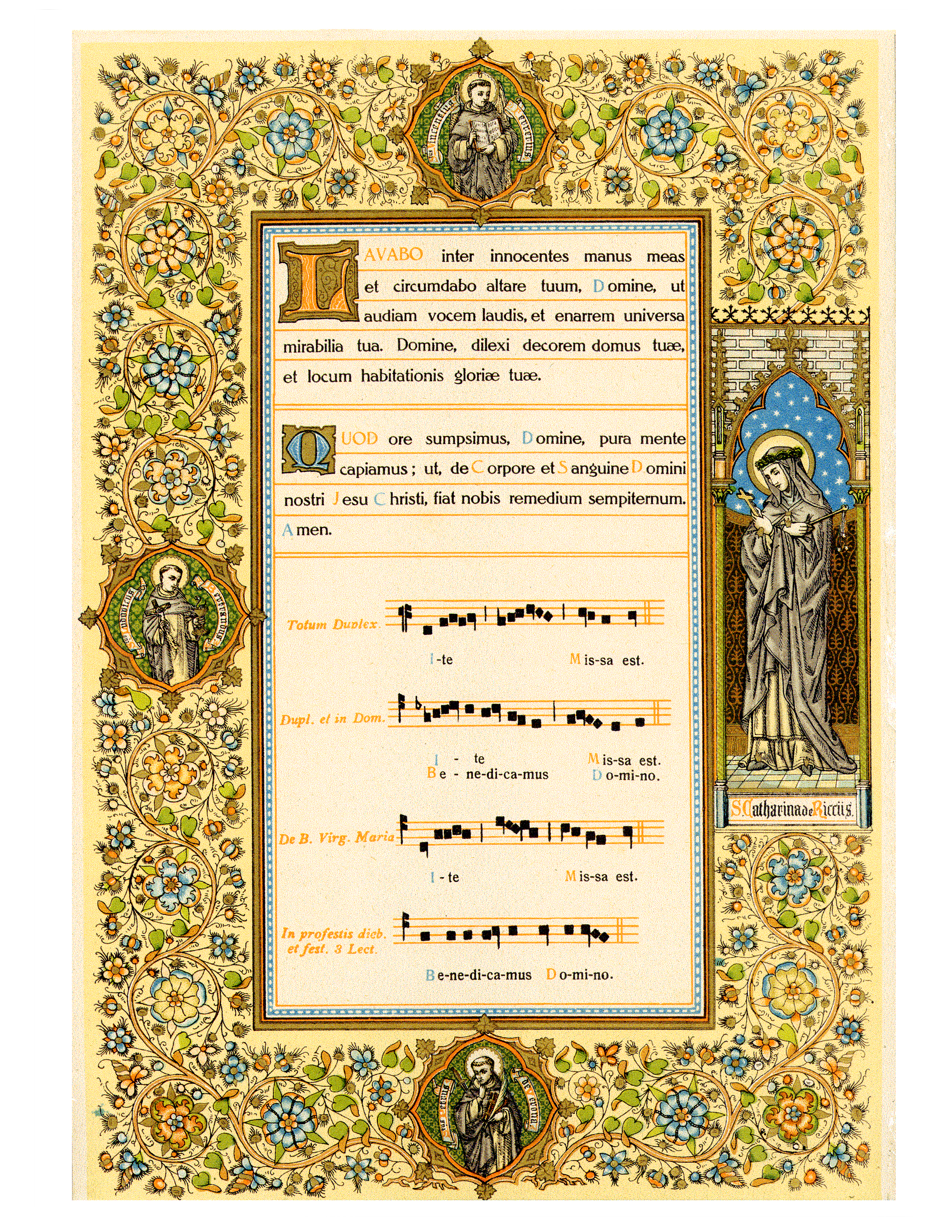
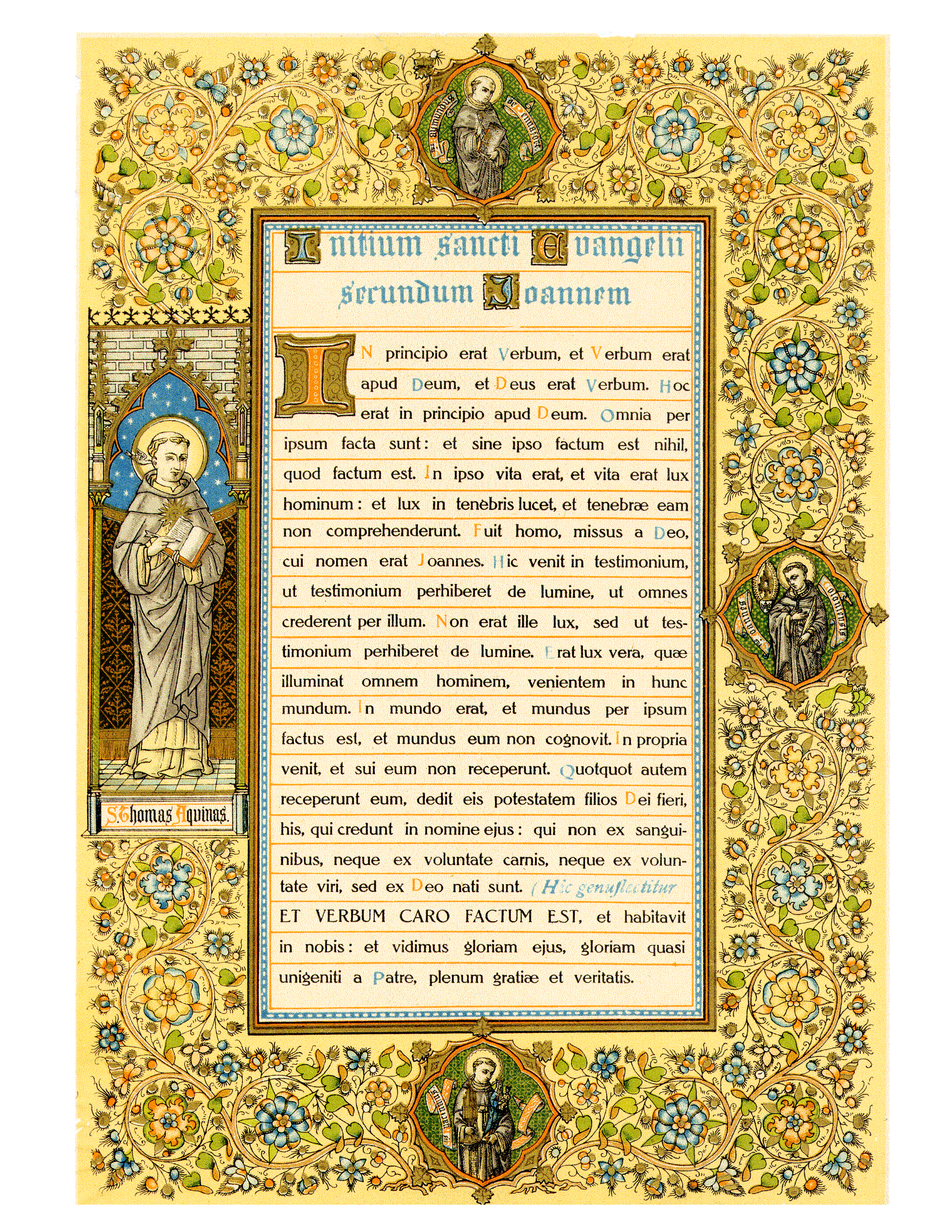
Dominican Altar Cards

I thought that some of our readers might be interested in seeing a lovely set of "Neo-Gothic / Fra Angelico" altar cards that are in the Western Dominican Province House of Studies, Saint Albert the Great Priory in Oakland. They usually grace the Sacristy, but are occasionally used at the high altar, most recently for the Solemnity of St. Albert the Great this year. The cards were calligraphed and the miniatures painted by two cloistered nuns of the Dominican Monastery in Menlo Park California for the dedication Mass of the chapel in 1948. Here is a picture of them on the high altar as it was dressed for the Solemnity:

The two smaller candles flanking the large six in this photo are the Sanctus Candles used at that Mass. Here is a closer image of the main card:

Two Fra Angelico angels grace the sides; in the bottom center is the old Coat of Arms of the Province of the Holy Name, the Western Province. In the top roundels, from left to right, we see St. Albert the Great, patron of the House and of natural philosophy; an angel; St. Thomas Aquinas, patron of theology; St. John and Our Lord at the Last Supper; St. Raymond of Penafort, the patron of Canon law, contemplating the Cross; another angel; and, finally, and St. John of Gorkam, who was martyred by the Calvinists in the Low Countries for bringing the Eucharist to Catholics in prison for their faith. The selection is very suitable for the House of Studies as it includes the patrons of theology, philosophy, and canon law, the major disciplines studied there. The other images are chosen because of their links to the Eucharist. Here is the Lavabo card:

In the left roundel , you can see St. Hyacinth of Poland, who carries a statue of the Blessed Mother, as he did when leading the Polish Dominicans to safety during the Mongol invasions. To the right is St. Vincent Ferrer, the great preacher, who was heard by people in their own languages--thus the fire of the Spirit of Pentecost over his head. In the center quatrofoil, St. Dominic mediating on the Cross. Those with sharp eyes will notice the the Dominican form of the Lavabo psalm is shorter than the Roman. Finally, here is the Last Gospel card:

To the left, we see St. Pius V, the reformer of the liturgy and pope of the Battle of Lepanto. As this victory over the Muslim invaders was through the intercession of our Lady of the Rosary, the Virgin and Child are in the center. Last, to the right, is St. Peter of Verona, also known as St. Peter Martyr because he was murdered by Cathar heretics in 1253. He is shown in his traditional form, reminding the friars to keep the Silence. Those with a very sharp eye will notice a tiny error in the punctuation of text of John's Gospel: it is the Roman form, not the Dominican. For more on this see my posting here.

Saturday, November 22, 2008

Dominican Missa Cantata of St. Albert the Great, 2008

On November 15, 2008, at Saint Albert the Great Priory, the Western Dominican Province House of Studies, a Missa Cantata according to the Dominican Rite was celebrated on the occasion of the installation of the new Master of Sacred Theology, who was the celebrant. Photos of this Mass have been posted on the photographer's website, the Western Province Website, and at the New Liturgical Movement.

For the convenience of our readers, and others interested, I have collected these here in one place and provided a short commentary. The first image shows the high altar of the beautiful chapel of the House of Studies.

The next image shows the celebrant and Bro. Ambrose Sigman, O.P., the senior acolyte, and Bro. Gabriel Mosher, O.P., the junior acolyte, waiting for the schola to being singing the Officium, "In Medio." They are standing in the passage way past the side altars leading from the sacristy into the Chapel.

Here are the community and visitors gathered in the choir stalls as the chant of the Officium begins. With the black cappa in the front row, opposite side, can be seen Fr. Gerald Buckley, O.P., the prior of St. Albert the Great Priory. In the blue Yale gown is Fr. Gerald Fogarty, S.J., Prof. of History at the University of Virginia, a colleague of the new S.T.M. Next to him is Donald Prudlo, Asst. Prof. of History at Jacksonville State University in Alabama, a former graduate student of the new S.T.M.

The celebrant and servers have here reached the high altar and are genuflecting before the Reserved Sacrament. You will notice that the celebrant still has his amice-covered capuce up, as a secular priest would still have on his biretta at this point. As the two servers are not ordained they wear the surplice under the shoulder cape of the capuce.


The celebrate as here returned from spreading the corporal and placing the chalice on the altar. With capuce down, he has begun the Prayers at the Foot of the Altar. During these prayers the servers turn in, as they would at Solemn Mass, and make the responses.


The priest has ascended to the altar, kissed it, and moved to the book. He is reciting the Officium quietly as the schola finishes it. The servers have swung to the side of the altar where the book is for the Officium and Kyrie, as they would with the major ministers at Solemn Mass.

After returning to the center to intone the Gloria, and again swinging to the side as for the Officium and Kyrie, the celebrant here returns to the center, turns to face the community and sings the greeting, "Dominus vobiscum."


He celebrant then returns to the book and sings the Collect. The Collect finished, he reads quietly the first reading (from Wisdom in this case) and the Responsorium (Gradual) and Alleluia. This next photo shows him completing that reading.


As he does these readings, the "cleric," who is in this case a priest, Fr. Bryan Kromholtz, O.P., who teaches theology at Dominican School of Philosophy and Theology in Berkeley CA. You will notice that as a priest he wears the surplice over the capuce cape. In the red Harvard robe, you can see Prof. James Gordley, of the Tulane University School of Law, who has collaborated on publications with the new S.T.M.

Here the two acolytes have arrived with the water and wine to help the celebrant prepare the chalice. This preparation is done during the singing of the Responsorium.

Here is the schola about to begin the Responsorium at the lectern "in medio chori." On a major feast such as the patronal feast of the House of Studies, the chantors should normally be at least four--here you can see there were six. They are from left to right, Bro. John Marie Bingham, Bro. Mark Francis Manzano, Fr. Paul K. Raftery (chaplain at St. Thomas Aquinas College in Santa Paula CA), Bro. Boniface Willard (who directed the schola), Stephen Maria Lopez, and Bro. Dominic David Maichrowicz. The visiting academics can all be seen in the front row.

Here we see the preparation of the chalice during the intervening chants. The senior acolyte ministers the wine and stands closest to the altar.

Sadly there are no pictures available of the singing of the Gospel by the celebrant. But here is a photograph of the V. Rev. Fr. Richard Aquinas Schenk, O.P., S.T.M., the regent of studies of the Western Dominican Province. As a Master of Sacred Theology, he wears the biretta and ring (not visible here). He is at the ambo and just about to begin his sermon on St. Albert the Great.

Here is the schola again, waiting for the celebrant to intone the Credo.

Genuflection at Incarnatus est in the Creed:


In the Dominican Rite, the Offertory is every simple, the chalice with paten and host on top is raised in a single oblation as the priest recites one prayer, Suscipe Sancta Trinitas.

Here was see the incensing of the altar at the Offertory. The priest has already incensed the gifts with a single crossing and then the top of the Epistle side of the altar with three lifts (Dominicans do not swing the censer, nor do we clank the chains). Here is has returned to the middle and is incensing the cross with three lifts.

The schola is about to intone the Sanctus.

He celebrant is here quietly reciting the Roman Canon.

The Elevation of the Host. The thurifer, Bro. Raymond Bertheaux, O.P., over fifty years a brother, incenses the elevation continuously, as is the Dominican custom. Earlier, during the singing of the Preface, he incensed the servers and community. In our rite the thurifer is present only from the Gospel to the Elevations, even in the Solemn Mass. You can see a lighted "Sanctus Candle" on the Epistle side (there is another on the Gospel side), which the server lighted during the Sanctus.

Closer view of the Elevation of the Host.

Elevation of the Chalice:


Here, during the singing of the Agnus Dei, we see Fr. Anselm Ramelow, O.P., Asst. Professor of Philosophy at the Dominican School of Philosophy and Theology, who is vested in surplice and stole as he will help distribute Communion. Bro. Matthew Augustine Miller stands in front of him.

Communion and the final collects finished, the celebrant recites the Last Gospel, folds the corporal, raises his capuce, and leaves the altar, as we see in this last photo of the Mass:


More on the program of studies and formation at St. Albert's can be found here. I can also post photos of the S.T.M. installation if readers would like them.